
What the ancient “holy kiss” can teach us about Christian community today
by Alden Bass

For Trinity Sunday, the lectionary pairs two texts that don’t obviously belong together: the Great Commission in Matthew 28 and the closing benediction of Paul’s second letter to the Corinthians (2 Cor 13:11-13), which includes the strange command: “Greet one another with a holy kiss.”
Christians don’t share the holy kiss anymore, but I think the ancient practice has something important to say about Christian community. This is an adaption of my sermon from that day.
“Go and Make Disciples”
The Great Commission is usually read as a missions text, a marching order for evangelism. But the order is less about mission work than about discipleship: “as you go, make disciples.” Jesus was asking his followers to establish discipleship communities — little outposts of the kingdom of God, where people could learn the ways of God and practice peace. “Peace on earth” is what the angels announced at his birth and what his death and resurrection made possible.
What does peace look like? Paul gives us a glimpse at the end of 2 Corinthians 13: “Be restored; listen to my appeal; agree with one another; live in peace; and the God of love and peace will be with you.” The goal of the community is restoration of the original creation, reconciliation to God and to one another. At the end of Jesus’s time on earth, the mission remained unfinished, and so he entrusted it to his disciples. They, too, lived and died, and still peace was not fully restored. So we have inherited the mission from them.
The German New Testament scholar Gerhard Lohfink spent much of his career thinking carefully about these discipleship communities. In his groundbreaking work Jesus and Community (familiar to many in NCN), Lohfink argued that Jesus intended his followers to form a “contrast society.” This was to be a visible, embodied alternative to the world, a community whose way of life challenged the hierarchies, divisions, and power structures of the dominant culture. Masters and slaves, Jews and Gentiles, men and women, rich and poor — all were called to be a single family, committed to economic sharing, forgiveness, and mutual love.
The Holy Kiss
Which brings me back to Paul’s awkward command: “Greet one another with a kiss.” It was obviously important. He mentions it in four different letters: Romans, both letters to Corinth, and Thessalonians. The fact that he did not have to explain the kiss or give detailed instructions tells us that this was an established practice, not something that Paul invented. Yet it seems to have been a uniquely Christian action. According to Lohfink, it was a revolutionary action.
In the ancient Mediterranean, a kiss on the lips or cheek was typically reserved for close family members or social equals. But to require it of everyone within the Christian assembly was a radical equalizer. A slave and a master, touching their lips together in greeting, were acting out something that no amount of theological language could fully express: that in Christ, the old social distinctions no longer held. The new family of God had trumped every old social division.
“A slave and a master, touching their lips together in greeting, were acting out something that no amount of theological language could fully express.”
Lohfink also pointed out that Paul’s kiss commands tend to appear at the conclusions of his most conflicted letters, like Corinthians. The church there was broken, riven by partisanship (sound familiar?). In that context, the kiss was not just a cultural greeting. It was a way of reconciling. To kiss someone you had been fighting with was to physically declare peace, to re-align yourself with the nonviolent, self-giving character of God’s kingdom. You couldn’t do it while holding a grudge.
But there is something stranger, even scandalous, here, which gets at the heart of what Christian community is. The “holy kiss” was not a little peck on the cheek in the European fashion according to Lohfink. It was an open-mouth kiss. The participants exchanged breath. The kiss was not intended to be sexual, but rather spiritual (in Greek, the words “breath” and “Spirit” are the same — pneuma). Paul had written in 1 Corinthians 12 that “we were all baptized by one Spirit into one body… and we were all given one Spirit to drink.” The exchange of breath made this visible and physical. We Christians share more than beliefs and practices — more, even, than the material goods and resources that intentional communities hold in common.
“We share the same Spirit: the breath of God, breathed into us at baptism and renewed week by week as we gather.”
Breath as the Carrier of Spirit
I have recently been reading Adam Johnson’s Wayfinder, a fantastic novel set in the South Pacific Islands. Johnson describes an ancient Polynesian practice found across the peoples of Tonga, Fiji, and Hawaii which immediately made me think of this strange holy kiss tradition.
When two Māori meet, they press their foreheads and noses together while simultaneously inhaling. It’s called the hongi, and the practice is rooted in the creation story of the first woman, Hineahuone, into whose nostrils the god Tāne breathed hā, the breath of life, to bring her into existence. When a visitor performs the hongi with the people of the land, their breaths intermingle. By sharing the breath of life, the visitor is no longer a stranger or a threat. They are incorporated into the community. By binding people together, the ritual actually creates a new community, a new family.
Hawaiians do something similar. Interestingly, the Hawaiian word haole, which generally means “foreigner” or “white person,” comes from hā-ʻole, meaning “without breath.” When Western sailors first arrived, they recoiled from the honi, offering a European handshake instead. Hawaiians named them for what they lacked: they were people who did not share breath. They stood outside the community.
There is a clear parallel with Lohfink’s analysis of the early Christian kiss. Both traditions recognize that breath is the ultimate equalizer, the carrier of spirit. Both traditions took a physical, bodily action and used it to turn strangers into family. Both rituals functioned to mark the boundary of community, not to exclude, but to include, to establish peace and equality within a community.
Though they lived in a completely different culture, the earliest Christians would have recognized this practice because they had a story of their own. In John 20, on the evening of the resurrection, Jesus came and stood among his traumatized disciples. He showed them his wounds. And then he breathed on them: “Peace be with you. Receive the Holy Spirit.” The risen Lord made peace among them by sharing his breath. The same Spirit that had animated his own life and ministry he now shared with his friends. They had been incorporated into divine life and mission, made family, by the sharing of breath.
The Triune Life as Our Model
But the sharing of breath in John 20 has a prior antecedent. What Jesus did for his disciples that evening was not totally new. It was a mirror of what God has always been. Our model for peace is not finally human at all, but Three-Personal life of God.
We worship a God who is, as one ancient confession puts it, “one God in Trinity, and Trinity in Unity; neither confounding the Persons, nor dividing the Essence.” God is not a solitary figure in heaven, isolated in divine self-sufficiency. God is, from eternity, a communion, a mutual indwelling, a perichoresis, a ceaseless exchange of love.
Augustine of Hippo, reflecting on the Trinity’s inner life, described the Holy Spirit as the “the bond of love” shared between the Father and the Son. This developed into the Western theological tradition’s understanding of the Spirit as the one who proceeds from both Father and Son: the mutual breath exhaled simultaneously by both. The life of the Trinity is an eternal, rhythmic exchange of the same divine breath. Father and Son, forehead to forehead, nose to nose, inhaling and exhaling the same spirit.
This is the shape of the life we are commissioned to imitate. Our gathering each week, our sharing of bread and wine, our calling each other brother and sister even though we come from many different backgrounds — all of this is a participation in God’s Triune life. We remain ourselves, yet we are one in Christ. Unity in diversity, “neither confounding the persons, nor dividing the essence.”
What We Practice Now
I am not proposing that we bring back the open-mouth kiss of peace in our assemblies. Our culture can’t handle that level of intimacy; as a society, we are rather nervous about touching generally. But we shouldn’t let this beautiful tradition go either, because it’s a picture of what we hope for, of what we’re becoming. We are being drawn into a life that is larger than any of us — the life of God, shared with us in the Spirit, enacted week by week and day by day in the ordinary acts of showing up for one another.
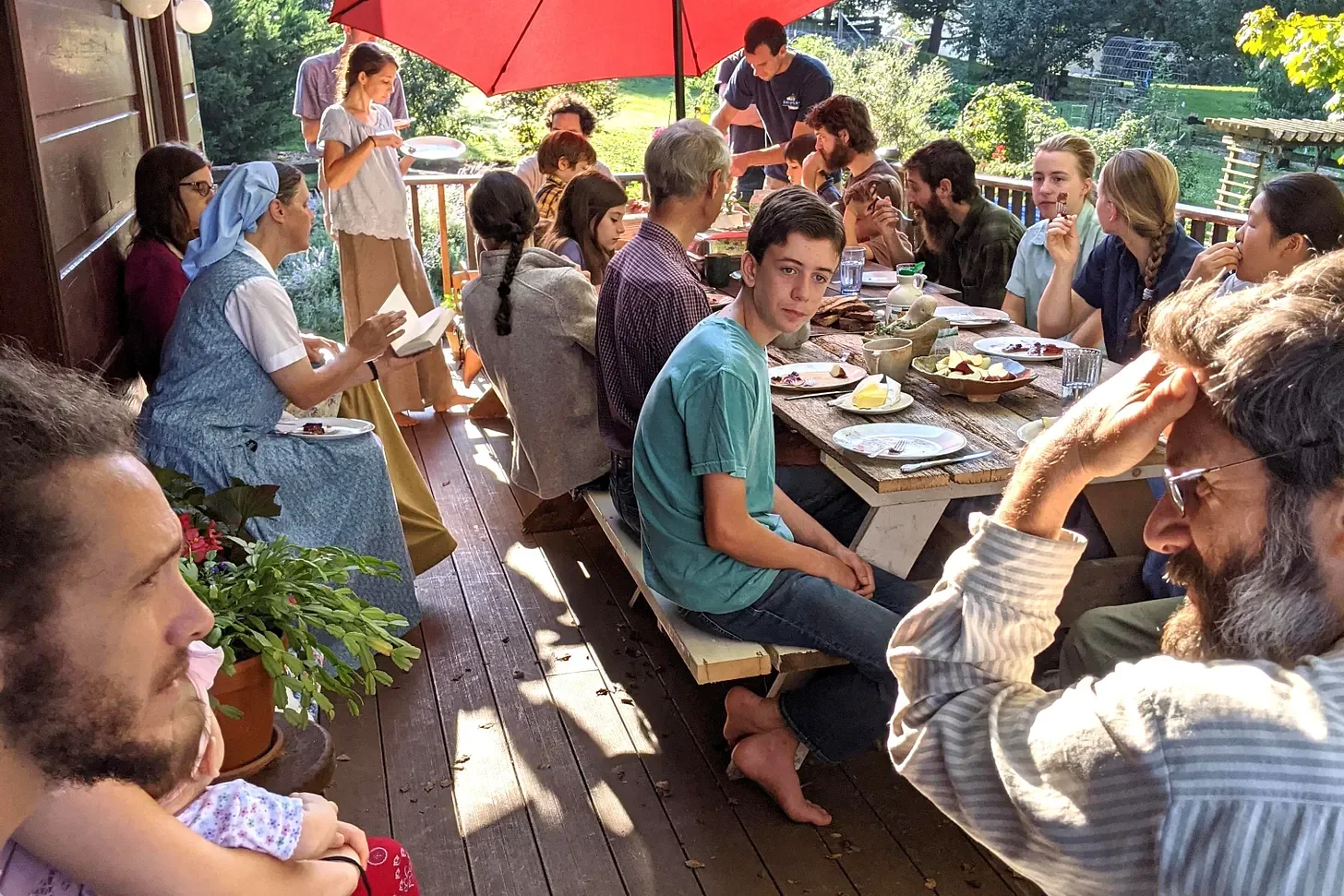
Christian community is a way for us to share more and more of ourselves at a bodily level: our time, our meals, our money, our presence in grief and in joy. Handshakes and hugs and the small daily acts of noticing each other: perhaps these are the modern equivalents of the holy kiss. They are the ways we say, across all our differences: we share the same spirit. We are one, as Christ is one with the Father.
That is what the upcoming Nurturing Communities gathering, “The Shape of Love: God’s Intention for Shared Life in Community,” is about. Don’t worry — we won’t be kissing each other! But we do want to remember that our life together is more than a mere human project or lifestyle choice or political strategy. It has a shape given to it from above, the shape of the Triune life itself, that eternal exchange of love between Father, Son, and Spirit. We are aiming at something more than temporal belonging, more than a supportive network of like-minded people. We are reaching, together, toward the fullness of unity and peace that God has always been and always intended for his creation. The gathering is a chance to celebrate that vision, to enjoy the fellowship of people who share the same Spirit, and to think together about how to share life more deeply, more boldly, more faithfully. Not the theory of community, but the practice. I hope you’ll come.
Dr. Alden Bass is Professor of Bible & Ministry at Hazelip School of Theology, Lipscomb University. He lives with his wife and children in Nashville, Tennessee.