
by Alden Bass
The history of committed Christian community begins not with buildings or institutions, but with roads. The first followers of Jesus called themselves "the Way," a name that echoes both the Jewish concept of halakha—the "way of life" enshrined in the Torah—and the disciples' conviction that Jesus was "the way" to God the Father. This simple designation would shape how Christians understood their communal life for centuries to come.
The Jerusalem Experiment
The earliest Christian community formed in Jerusalem immediately after Jesus' execution, composed of the original disciples and pilgrims who had traveled to the city to celebrate the holy days. United by their conviction that Jesus' resurrection signaled covenant renewal and the dawn of a new creation, these Jews marched through the Red Sea of baptism into a radically transformed way of life.
What emerged was nothing short of revolutionary. All possessions were held in common. There were no needy persons among them. All members were "of one heart and mind." The spirit of ancient Israel's jubilee traditions engulfed the Holy City, and for a brief, shining moment, the utopian community envisioned in the Torah was actually reconstituted in lived experience.
This experiment in radical economic sharing and communal living wasn't simply an administrative choice or social program. It was the natural outpouring of a people who believed they were witnessing the breaking in of God's kingdom, a concrete embodiment of the new creation they proclaimed.
Fleeing Jerusalem, Carrying the Vision
Eventually, war drove all Christians and Jews from the land. The physical community in Jerusalem was scattered, dispersed along the dusty roads and pathways that connected the ancient world. Yet the traces of that original movement were so deeply impressed in their collective memory that the disciples who fled Jerusalem continued to establish countercultural communities wherever they went—communities marked by economic sharing, scripture study, participatory worship, and service to the poor.
These first Christians literally followed the path pioneered by Jesus, wending their way through a landscape filled with other intentional communities. In the early centuries of the Common Era, various fraternal associations organized themselves around mutual aid, bound together by profession, religious devotion, or voluntary adherence to common principles. Christian communities existed alongside these groups but distinguished themselves in a crucial way.
What Made Christian Communities Different
Writing in the third century, Tertullian observed that Christian communities differed from other associations primarily in their charity to the underserved. While other groups might care for their own members, Christians extended their care beyond their immediate circle, serving those whom society had cast aside.
Groups of Christians organized themselves into economic communities called parishes. The word itself carried powerful meaning—derived from the Greek paroikia, which meant both "neighbor" and "sojourner" or "pilgrim." Just as "parish" sounds similar to "pariah" in English, the name would have reminded Christians that they were outcasts and exiles in a foreign land, not fully at home in the broader society that surrounded them.
Life on the Road
The physical conditions of early Christian life reinforced this sense of pilgrimage. Palestinian roads were treacherous affairs—packed earthen pathways, usually narrow, winding around the many mountains of the region. Persecution forced whole families of Christians to follow these dusty trails to new cities, where they formed tightly knit communities of a few dozen people.
In times of difficulty, Christians depended on one another for survival itself. When Christians were imprisoned for their faith, they counted on the community to bring them food and care for them. When families fled persecution, they knew they would find shelter and support in the next city's Christian community. Such pressures bound the parish together into a family unit, sometimes explicitly called "the household of faith."
This interdependence wasn't merely practical—it was theological. The early Christians understood themselves as members of one body, connected to Christ and to one another in ways that transcended biological family or ethnic identity. Their economic sharing wasn't socialism or communism in any modern sense; it was the natural expression of their belief that everything they had came from God and belonged ultimately to the community of faith.
Roads of Empire, Roads of Change
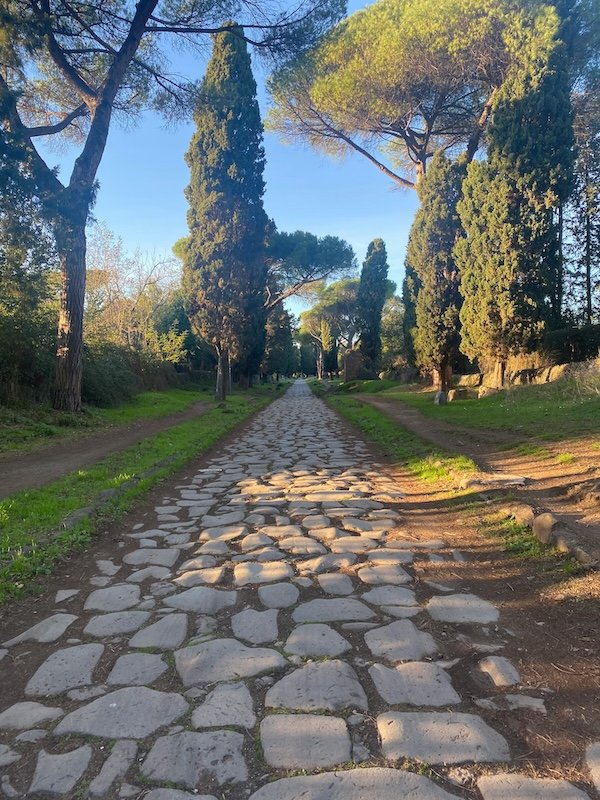
The development of Roman highways dramatically altered this dynamic. These magnificent roads—between eight and thirty feet wide, built in carefully engineered courses of gravel, sand, and pavement, designed to efficiently drain water away—not only made travel easier but also aided the spread of Christianity throughout the empire.
Yet these same roads that facilitated Christianity's expansion also changed its nature. As external pressures relaxed and Christians no longer faced the same intensity of persecution, their dependence on one another likewise waned. The parish, once a tight-knit community of mutual aid and economic sharing, began to transform.
By the end of the third century, the parish had morphed from a countercultural community into an administrative jurisdiction of the institutional church. This shift occurred at different rates in different regions, but the trajectory was clear. By the end of the fourth century, Christianity had become the official religion of the Roman Empire and was firmly established in major urban areas.
The Tension That Endures
From this pivotal moment until the modern period, Christians in Europe would live in a fundamental tension—caught between a supposedly "Christian" society that was Christian in name but often not in practice, and the communal ideal of the early church that called for radical economic sharing and mutual dependence.
This tension would never fully resolve. Instead, it would generate wave after wave of reform movements, each attempting to recover something of that original vision of the Jerusalem community. Some would flee to the desert to seek God in solitude. Others would form new kinds of communities within cities. Still others would cross oceans to establish fresh experiments in Christian communal living.
But all would look back to those first communities on the dusty roads of Palestine, where believers truly held all things in common, where there were no needy persons among them, and where they were all of one heart and mind. That memory would continue to haunt and inspire Christians for two millennia, a reminder of what Christian community could be when followers of the Way truly walked the road together.
The story of how Christians have responded to this tension—how they have repeatedly attempted to recapture that original vision while adapting it to new times and places—is the story of Christian community itself. It's a story that continues today, wherever believers gather to share their lives, their resources, and their commitment to following Jesus together on the Way.
Adapted from Two Millennia of Christian Community, a chapter of Called to Community (Plough, 2016).
A free copy of the paperback book is available on request. Email ncnplough@gmail.com with your name and address.
Alden is a member of the NCN steering committee and teaches at Lipscomb University in Nashville.